
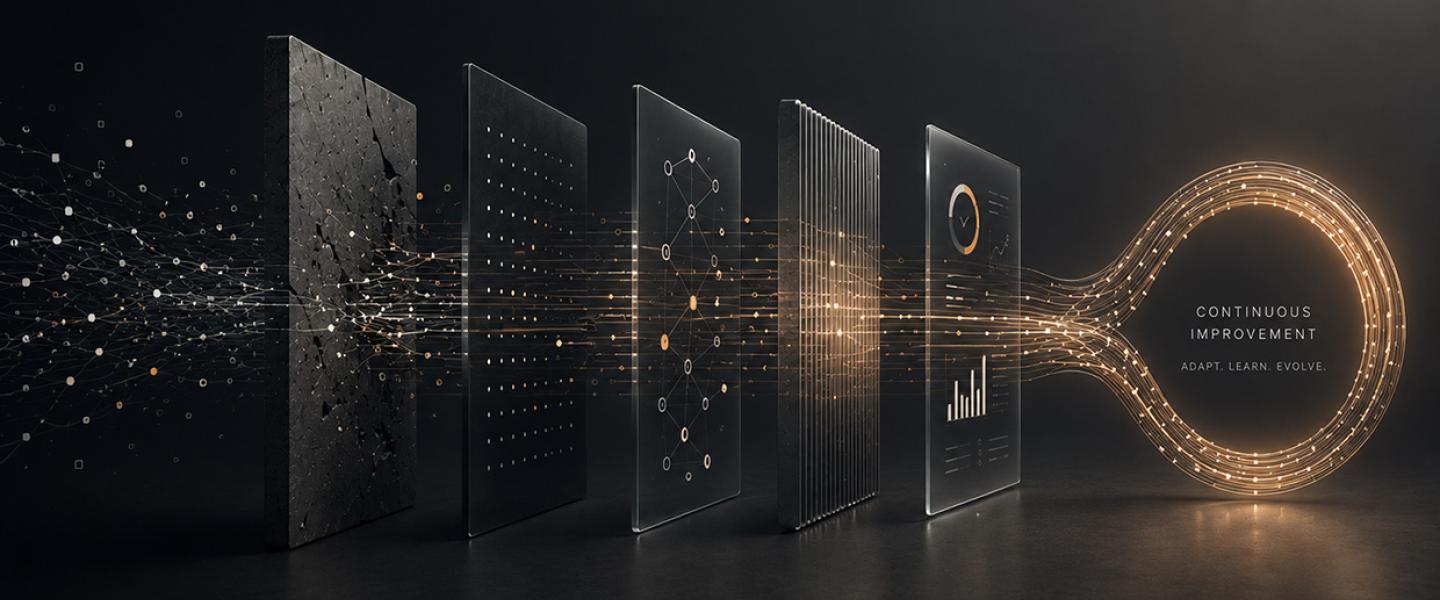
A Keido perspective on building adaptive, human-aligned schedulers and optimisation engines.
In every industry, the pressure to optimise is accelerating. Whether it’s a mining operation coordinating complex equipment movements or a research organisation balancing competing priorities, teams are increasingly turning to AI-driven schedulers to make faster, sharper decisions.
And yet, many optimisation projects stall. Not because the technology is flawed, but because the process used to build it is incomplete.
Recently, a mining-sector optimisation specialist outlined their approach:
- identify the problem
- architect a solution
- test it
- then automate the system so it can rebuild itself
It’s a solid technical loop, but it skips the human context, the alignment mechanisms, and the success definition required for real-world adoption.
At Keido, we take a more holistic path. We design AI systems that scale because they are built around the people who rely on them and because they are engineered to stay aligned long after deployment.

Here’s how that process works.
1. Start with the problem and frame it for impact
Every optimisation journey begins with a clear definition of the challenge.
But the real work is understanding why it matters: the operational constraints, the downstream dependencies, and the type of decision the scheduler must support. We make the problem legible, measurable, and transparent, because ambiguity at the start compounds later.
2. Define the personas who will live with the system
A scheduler does not operate in a vacuum. It serves multiple people with different goals, pressures, and risk appetites.
- Operators need clarity
- Supervisors need accountability
- Planners need flexibility
- Leaders need confidence.
By articulating these personas early, we ensure the system is not just technically correct, it’s usable, trustworthy, and shaped around real human workflows.
3. Establish what success looks like, before any architecture is built
Technical teams often rush to building. We slow down first.
Success criteria anchor the project and protect it from drift. They may include:
- Precision and similarity thresholds (e.g., ≥0.92 against a validated schedule)
- Performance guarantees
- Interpretability requirements
- Persona-specific usability checks
This step turns "we think it works" into "we know it meets the standard."
4. Build test cases that represent the full reality per persona
Schedulers fail in the edge cases, not the easy ones.
And they succeed when each persona sees their needs reflected in the way the system behaves.
We design test cases that map to real operational pressures: unexpected outages, competing constraints, shifting priorities, and the subtle judgements people make every day. These become the alignment tests that the architecture must satisfy.
5. Architect the system to meet the requirements and not the other way around
Only once the context is clear do we design the engine.
The architecture spans data ingestion, optimisation logic, constraints, explainability, workflow integrations, and reporting. Each component is built to pass the persona-aligned test suite and uphold the pre-defined success criteria.
This is where technical precision meets behavioural insight.
6. Iterate looping between test and architecture until it holds under pressure
Real optimisation isn’t linear.
We continually cycle:
- build → test → evaluate → refine
The standard is met only when every persona’s scenario passes, and the system performs consistently in both typical and extreme conditions. This loop strengthens the model and increases organisational trust.
7. Enable the system to self-monitor, self-adjust, and signal when it needs help
The final evolution is autonomy.
A mature scheduler can:
- detect drift
- identify degradation
- retrain or rebuild itself
- adapt to new constraints or operational patterns
- escalate when human judgement is required
At this stage, human involvement shifts from manual intervention to strategic oversight. The system becomes a partner alert, adaptive, and accountable.
The outcome AI systems that stay aligned with reality
Keido’s approach is simple, being build AI that earns trust, performs under pressure, and remains aligned as conditions shift.
By embedding personas, defining success upfront, and engineering for continuous adaptation, we design optimisation systems that don’t just solve today’s problem they stay sharp as tomorrow unfolds.
If your organisation is exploring AI-driven scheduling or optimisation and wants a system that’s not just intelligent but human-aware, we’d love to help you shape the path forward.